Showing posts with label mini garden. Show all posts

Sunday, August 03, 2008

Phygelius aequalis (Yellow Trumpet)


Hello again

After some really impressively heavy rains day before yesterday and yesterday, as well as – probably – last night, the sun came out and the day was lovely and warm, with a gentle breeze.
I simply had to go out and do some work in the "garden". It's actually just a twenty-inch deep bed of excellent to moderate to poor soil that runs along the south face of our house. I've put down some nasturtiums that I salvaged from a compost heap on Iona -- they're doing ok here. I've also sown some seeds that I brought with me and will be most interested to see what actually comes up.
And I pruned back the fleshy shrub that I cut some branches of in May to make quite a spectacular bouquet in May. It made the most tremendous mess on my hallway floor as it dripped with sugary sap from its tiny trumpets. Impressive! So I decided once was enough and I would enjoy the flowers out of doors, and -- most importantly -- let the dozens if not hundreds of bumblebees come and enjoy the nectar.
As I said, I pruned it back. It was still crowding out a lovely, if mangled blue lavender on its left, and grew all over a lovely bright red wild fuchsia shrub on its right. And, more importantly, its flowers had been pollinated and had ripened into clusters of dozens and dozens of seeds. Not sure I want that sort of proliferation. And I was also not too sure whether those seeds might be dangerous to the still small children in the house next door. So, I took my little seccateurs to it and cut out all the branches that were bearing fruit, and continued, taking out more branches. From what I've seen, I'm sure it will grow back and probably make another round of flowers. One branch has already begun to flower again, actually. Maybe the cold spell we had made it feel like it had just come through winter...
As I freed up some of its bigger, older stems, I found the tag. Who knows how long it's been there but the price was still on: £5.95 -- a lot of flowers for a modest amount of money indeed! And the tag says it's Phygelius aequalis – Yellow Trumpet.

According to http://web1.msue.msu.edu/imp/modzz/00002087.html), it is an annual plant, but I think it will be a perennial as I doubt that this was planted only this past spring. Anyway, for what it's worth, here's the comment from that website:
Phygelius aequalis
Height: 18 in Spacing: 18 in
Type: annual
Flowers: Yellow, pink
Comments: This tender perennial is best grown as an annual. The flowers are trumpet-shaped and borne in clusters at the stem tips. The plant requires a sunny exposure and a moist but well-drained soil. The plant is native to southern Africa.
Cultivars: 'Yellow Trumpet' - Yellow to greenish-yellow flowers are borne on bushy plants.
References for Cultivars: White Flower Farm 1999.
****
The tag reads:
Phygelius aequalis – Yellow Trumpet
Although not strictly a climber, in most areas this sub-shrub is best grown on a south facing wall when it will grow much taller than if free-standing. Clusters of pendant tubular flowers open in summer and autumn.
Height and spread: 90 cm (3 ft) or more. [I think it grew to at least 1,2m tall and propagates so easily it actually feels like rather an invasive weed. Some of its extensions have grown behind the drainpipe and are really tough to get out of there.
Any branch that touches the ground takes root very quickly and new leaves emerge within about a week.]
Position: Well-drained soil in sun.
Planting: Water thoroughly or stand container in water for an hour before planting. Plant in hole large enough to avoid disturbing root ball. Back-fill with soil previously mixed with peat substitute and a suitable fertilizer.
Plant care: Support with trellis if grown on a wall.
****
Wikipedia has a good photograph, and an alternative name, i.e. "Cape fuchsia" (although it bears no relation to fuchsias): http://en.wikipedia.org/wiki/Phygelius_aequalis -- it's from the
Scrophulariaceae, or figwort family.
On the Phygelius page of Wikipedia (http://en.wikipedia.org/wiki/Phygelius), this is what I found:

Phygelius (E. Mey.ex Benth.), Cape fuchsia, is a genus of the Scrophulariaceae family. The genus is native to southern Africa. The plants are adapted to surviving severe summer conditions. Phygelius is not related to the Fuchsia genus, in spite of the common name.
About fifteen cultivars are available for gardeners. Some are hybrids between the two known species. Development of the cultivars has taken place primarily in England in order to create varieties better fitted for the colder climate.
Species of Phygelius

There are currently two species in this genus:
Phygelius capensis
, Cold hardy cape fuchsia.
Phygelius aequalis
, "Yellow trumpet" (var).

****

Well, that's one little mystery solved... I look forward to your comments. :)
Peace!

Thursday, October 12, 2006

Mini garden in autumn

Hello again

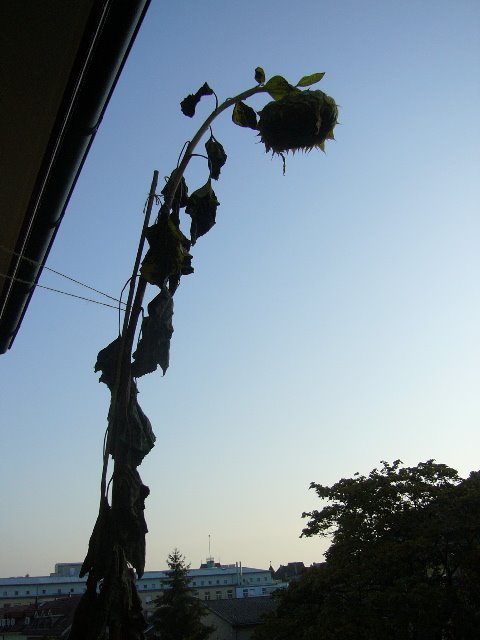
Remember the sunflowers in one of my earlier posts? Well, this is the season to say good-bye to things and to trust in the power of nature to renew itself while it goes into the more passive state of late autumn and winter.

At my office we will be celebrating the Celtic New Year (Nov. 1st) because we find it fitting to celebrate the beginnings that are not yet visible to the human eye.

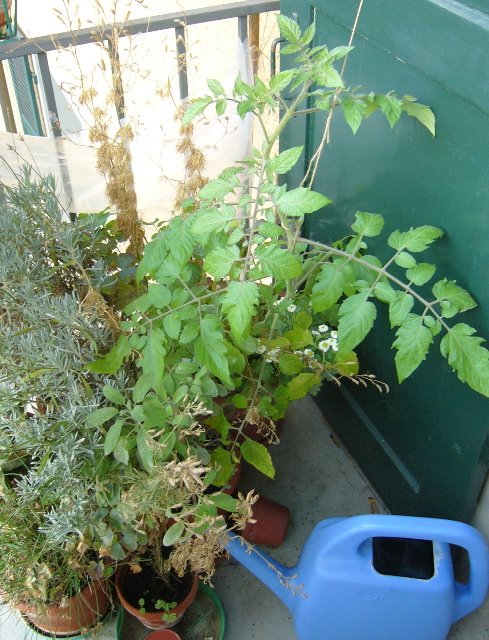
Here are some images from my little balcony. The sunflower will soon be chopped down because the August rains caused its seeds to just rot with mildew. It's a sorry sight and depressing to behold.

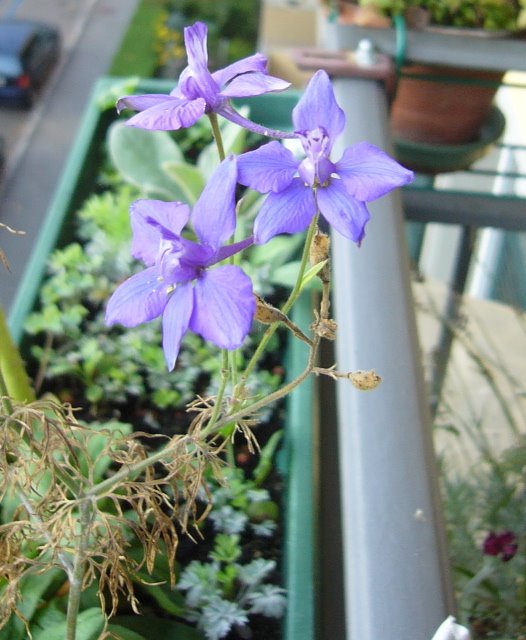
But, and that's the beauty of nature, there are new things growing: a delphinium rallying once more into bloom...

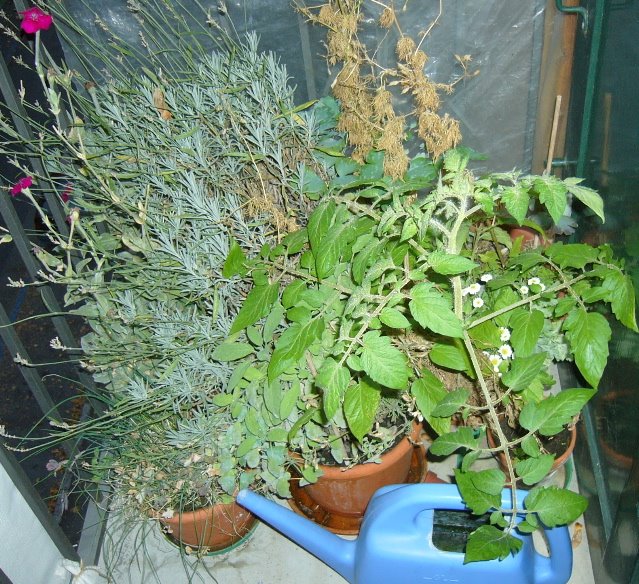
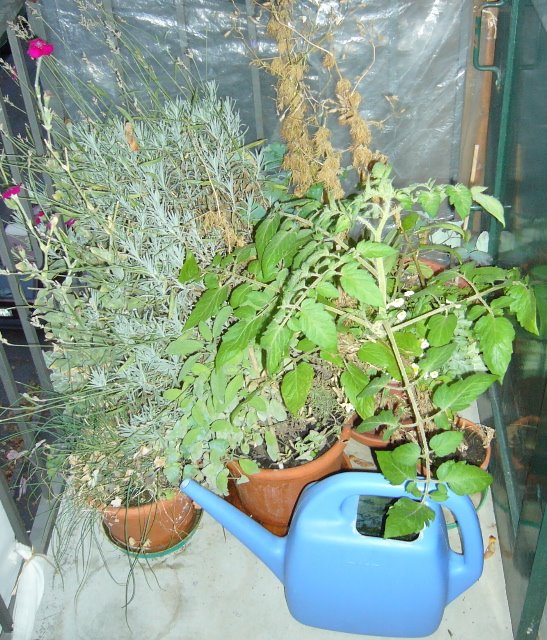
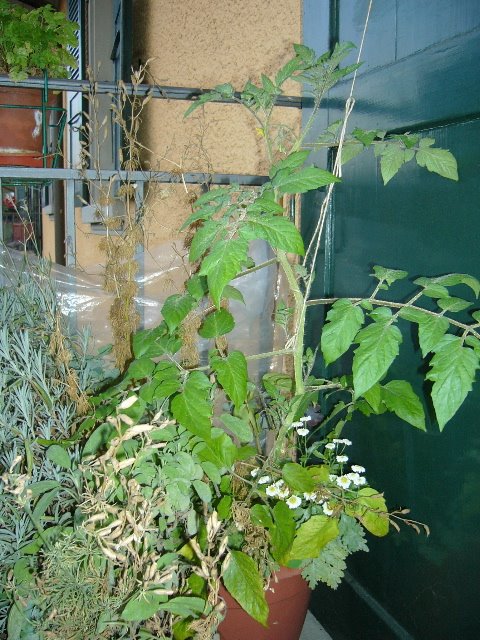
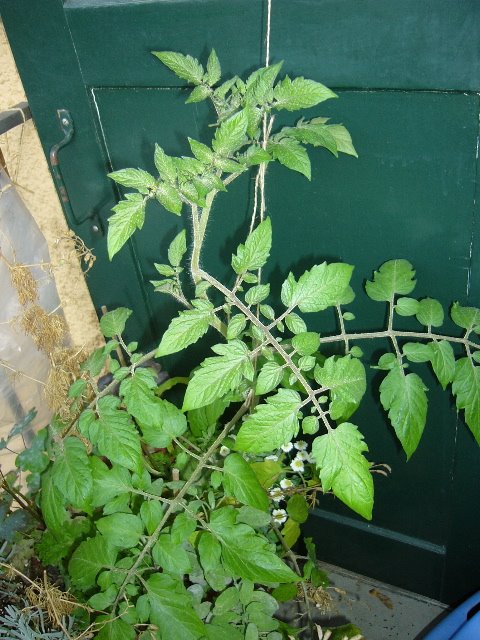
Some Roman camomile is also flowering again. Most importantly, a self-seeded tomato plant has been pushing up and out and even carries some flowers. I doubt whether they'll have time to grow into actual fruit before the real cold -- we've had chilly nights of around 5°C -- but the feistiness of this plant cheers me up no end.

See for yourself, if you will! :)


Thank you for your time and attention. Come back soon!

Saturday, June 24, 2006

Mini garden (for my Mum)

Liebs Mueti, dear friends
I promised to let you have a look at my new summer furniture and, while I'm at it, I'll show off some of my more successful mini-garden experiments.
The sun and Mr. Blackbird, a feisty specimen, woke me early one gorgeous May morning (May 24, 06, to be precise), in time to catch the light playing on my pride and joy, aquilegia (or columbine). They have been coming back spring after spring after spring. Very healthy looking after a long, harsh winter that killed off a lot of the aphids that usually sweep in from the sycamores opposite. Mind you, the ladybugs follow in hot pursuit. Their larvae have a particularly voracious appetite and gobble up aphids (or greenfly) galore.
By the way, the red flower in the middle is a nodding Ranunculus asiaticus var., or «Ranunkel» or Persian buttercup or Garden ranunculus, a gift from my brilliant neighbour, D., who usually looks after my plants when I'm away. On my return from my spring holidays, I found red and white buttercups and blue forget-me-nots -- the tricolor of the Union Jack! -- , oh and a bunch of purple-and-yellow little pansies planted in my boxes. Lovely! I'm hoping to coax the buttercups through to next year. The forget-me-nots and pansies will take care of themselves; already they're producing lots of seeds!
To go back to my columbines, even in a less than perfect year, they can look pretty good (the following photo is from 2004):
Remember that glorious May morning? Interesting effects of the brilliant sideways light, don't you think?
I'm particularly proud of the little very dark columbines grown from seed I received as a gift from one of the botanists at the local botanical gardens:
In previous summers, this is what caught my eye most days: columbines and orange California poppies were thriving in the same box last June (05) as a sunflower was muscling in and a Rose campion (Lychnis coronaria) made the most of its sunny position. 3)
From a different angle, another great favourite, delphinium grown from seed taken from flowers in a birthday nosegay. Aren't they simply gorgeous?
Last year, I left the withered plants out for a long time and was fascinated to find that little Eurasian great tits (Parus major) came to feast on the seeds, dangling upside down on stalks that seemed much too thin for their weight.
Some sturdy-looking specimens of Roman camomile grown from seed from one of my Mum's birthday bouquets for me are coming up now and will soon be in flower. They're unstoppable (the next photo was taken on June 20, 06, and shows the camomile competing for attention with one of my prize columbines and Dago's pansies, still going strong after ceaseless flowering for the past two months and more):
Did I say Roman camomile? Cheers to anyone who comes up with the proper latin name of this plant for me. :)
P.S. added May 28, 06, after receiving a comment from «R» -- for which much thanks, whoever you are, «R»:
«R»'s comment has prompted me to stop being lazy and search the Web for some botanical info on this plant (see end for credits). I'm amazed at the aptness of this flower being here, on a post dedicated to my Mum. :)
What I call «römische Kamille» or Roman camomile has many, many different names, both in Latin, German and English (and other languages). Let's begin with the Latin:
«R» mentioned Chameamelum nobile, which is fine. But then there's Chrysanthemum parthenium,Matricaria parthenium, Chamomillae romanae flos, Anthemis nobilis L, Ormenis nobilis (L.). Earlier botanists used Anthemis chamomilla-romana (CRANTZ), Anthemis odorata (LAM.), Chamaemelum odoratum (DOD.), Chamomilla nobilis (GOD.), Leucanthemum odoratum (EID. AP.), Lyonnetia abrotanifolia (WEBB.), Matricaria nobilis (BAILL.) and Ormenis aurea. [1)]
In German, «römische Kamille» and «Mutterkraut», which indicates a gynecological use, «Mutter-» not only denoting mother but also the womb or uterus.
In English, we've already had Roman camomile (or chamomile). It's also known as English chamomile, garden chamomile, Garden-scotch, Ground apple, Low chamomile, noble chamomile, Russian chamomile, Small chamomile, Whig plant. One author [2)] bought her seeds in England under the name of Feverfew, aka Matricaria (or Chrysanthemum) parthenium, which loops us back to «Mutterkraut», and to my Mum.
Thank you, «R», this has been quite a trip!

My interest in flowers was originally nurtured by the women in my family, and here's a homage to my mother, who -- year after year -- spoils me with flowers straight from her huge garden. This year will likely be the last because my parents recently bought a new flat and are hoping to sell the old house to someone motivated to take on a project.
Thanks for the flowers, Mum, and for everything!
This year's early birthday nosegay from Mum's garden -- yes, the garden's still there, and the foxgloves are particularly stunning just now. See for yourself:
Over a week later, a day before the big day -- June 23 for anyone desiring to post their birthday wishes to me ;) -- they're still looking good:
And the last Birthday Bunch is absolutely spectacular -- thank you, Mum! Shame you can't enjoy the perfume of the rose and the Dianthus barbatus. Pure magic!
These are for you, Mum:
P.S. (added June 20, 06): I don't remember ever having columbines in full bloom beyond mid-June, still flowering when the delphiniums come up. Well, this is an extraordinary summer, with spring compressed into two weeks, temperatures up by 20°C within just a few days, then down again by 10°C within a couple of hours -- crazy! Here, by the way, is what I mean. And no, I used no genetic modification to produce the sunflower with the delphinium blossoms... :)
TTFN and thanks for your time! :)

1) According to http://www.pharmakobotanik.de/systematik/6droge-f/chamrofl.htm -- excellent source (German).
2) http://www.museumsgarten.de/mutterkraut.html -- a great website (German/English) with lots of photos, sadly not updated since 2004.
3) On my birthday, June 23, thank you to Kathy Miller in the Pacific Northwest, who has some stunning, highly professional flower images, among them Lychnis coronaria (if you google that name, you'll be bound to find her site).