My neighbours planted lots of pansies and petunias -- glorious colours -- which are
struggling to survive the tight embrace of some
Cerastium vulgare or Common Chickweed, a weed if I've ever seen one!
Luckily, it comes out quite easily as its root are quite superficial.
Today I want to honour the wildflowers, herbs, shrubs and ornamentals that grow in my garden, near our house and in the patch of wilderness at the bottom of the garden as well as across the burn.
As you come up the hill towards the terrace of flats I live in, a cherry tree and a rowan tree welcome you on your right:
 The cherries are long gone, of course, picked by a large flock of jackdaws -- they were having a ball! But the rowanberries are just beginning to look their bright orange ripeness.
The Epilobium hirsutum, one of my favourite "weeds", is a fairly tall, in-your-face flowering plant of the willowherb genus in the Onagraceae family. According to Wikipedia, it is commonly known as the Great Willowherb, Great Hairy Willowherb or Hairy Willowherb. Local names include Codlins-and-cream, Apple-pie and Cherry-pie. Yummy names. No wonder I really like it... :) [in German: Zottiges Weidenröschen]

 A few stands of Hairy Willowherb grow at the bottom of our garden, north and south of the wooden fence around the bin enclosure.
 According to the website http://epilobium-parviflorum.com , the Epilobium parviflorum or Small-flowered Willowherb has medicinal properties, so I was probably wrong getting rid of the hundreds of plants that felt like an infestation all over the garden:
-- A few minutes later:
Well, I was definitely wrong to pull out so many of these inconspicuous but highly medicinal plants. See what the famous Austrian botanist and pharmacist, Maria Treben, has to say about the herb at http://epilobium-parviflorum.com/maria-treben-willow-herb.html.
Apparently, it works wonders on men with prostate problems and people with urinary and/or kidney complaints. As I think this is really important information -- I am beginning to know too many men with prostate problems, if not actual prostate cancer and am hoping this will benefit lots of people -- here comes the entire article from the website quoted above (and if you click on the title of today's post, you'll be taken straight there, too):
***quote from here to *****
Maria Treben Medicinal Use of Willow Herb
Austrian herbalist, Maria Treben speaks of Small Flowered Willow-herb:
Once I received a letter from a family man in which it said, I quote: “I beg you to show me a way back to health and give my family back their healthy father.” Before, he had related his story: In 1961 a chronic inflammation of the prostate gland became acute through bathing in water containing radium. He went from one hospital to another, no doctor operated on him, he was in despair. Every time he had a bowel movement, there was pus and blood in the stools. Due to the many medications he developed duodenal ulcers, serious liver disorders and the valuable intestinal bacteria were destroyed. He became very sick and, on the doctor’s orders, had to stop all medication. Then he was, as he wrote, operated on electrically. Despite the operation the inflammation did not clear up. Medications and injections worsened his condition again. Then he started to drink Stinging Nettle tea and a special tea for bladder trouble, which improved his condition so far that he was able to go back to work. He could have spared himself all this suffering had he but known the Small Flowered Willow-herb which can cure disorders of the prostate gland.
The Willow-herb, until now hardly found mentioned in herbals, has since the first publication of this book in the German language started an almost triumphal march across Europe and even further, as a medicinal herb for disorders of the prostate gland.
Since there are several species of Willow-herb and some people are uncertain which are the ones with the medicinal properties, I will mention the ones that can be used: Pink Willow-herb (Epilobium roseum), Small flowered Willow-herb (Epilobium parviflorum), Mountain Willow herb (Epilobium montrum), Dark-green Willow-herb (Epilobium obsurum), Lanceleaved Willow herb (Epilobium lanzellatum), Hill Willow-herb (Epilobium collinum), Marsh Willow-herb (Epilobium palustre), Gravel Willow-herb (Eiplobium fleischeri), and Alpine Willow-herb (Epilobium anagalidifolium). The Willow-herbs with the medicinal properties are recognizable by their small flowers. The colour is reddish, pale pink to almost white. The flowers stand on top of the long thin pod-like seed vessels. These later split, disclosing many silky white hairs in which are embedded the tiny seeds.[MPJ's emphasis]
Of the varieties mentioned, the whole herb is gathered, that is, stems with leaves and flowers, but care should be taken to pick the herb in the middle of the stem – it breaks easily – so that it can form new side shoots. The plant is cut in fresh state. Even in the most severe cases only 2 cups of Willow-herb tea are drunk, 1 cup in the morning on an empty stomach and 1 cup in the evening. But it does not mean that a visit to the doctor is not necessary. In any case, for every serious illness, a doctor has to be consulted. [MPJ's emphasis]
Two species of Willow-herb which can hardly be mistaken for the smaller species are the Great Hairy Willow-herb (Epilobium hirsutum) and the Rose Bay Willow-herb (Epilobium angustifolium). These must not be gathered. The first has large rose-purple flowers. It grows much branched, in masses in ponds, in marshes and damp meadows and reaches a height of 150 cm. The stems and leaves are fleshy and slightly hairy. The Austrian botanist, Richard Wilfort, who knows the Willow-herb as a medicinal plant well, does not mention it in his book. As he said, it could be easily mistaken for the Great Hairy Willow-herb which, compared to the Small Flowered Willow-herb, has flowers 5 times as large, its stems and leaves are fleshy and it grows a lot taller, but has the opposite effect. The Rose Bay Willow-herb (Epilobium angustifolium) also known as Fireweed, Blood Vine, Blooming Sally, grows in copses, waste grounds, recently cleared and edges of woods and reaches a height of 150 cm. The slightly reddish stems end in long showy spikes of rose purple flowers. When these abundantly growing Rose Bay Willow-herbs flower, they turn areas into fire-red patches. [MPJ's emphases]
I was a young woman, when my father-in-law, in his prime, died from hypertrophy of the prostate gland. A neighbour who knew a lot about herbs showed me the Small Flowered Willow-herb and said: “Had your father-in-law drunk the tea made from this plant he would still be alive today. Take note of this plant! You are still a young woman and you might be able to help a lot of people.” But as things go when one is young and healthy, I did not trouble myself about it. Not so my mother! She gathered Willow-herb every year and was able to help many people suffering from bladder or kidney disorders. The curative effect is so, that quite often, suddenly all complaints caused by prostate disorder disappear. There were cases, where men were to have an operation; the urine came only in drops and 1 cup of this tea brought relief. Of course, the tea has to be drunk throughout a period to bring about complete recovery. [MPJ's emphasis]
Through my mother, I heard of a patient who had undergone 3 operations for clinically diagnosed cancer of the bladder and who was in a sad state. I recommended Willow-herb tea. Later I heard from his doctor that he had recovered. This happened at a time when I did not concern myself with medicinal herbs. But this case had a lasting effect on me. My mother often told me not to forget to gather Willow-herb should she be gone one day. In 1961 my dear mother died and I forgot to gather Willow-herb that summer. In the surgery of my doctor, I learned that an acquaintance of mine was in the hospital with cancer of the bladder. I thought of the Willow-herb. The doctor, although not against herbs, said that in this case nothing could help. But I had not gathered any Willow-herb and noticed with dismay that it was now the middle of October, everything would be wilted and dried up. Nevertheless I went to a place where I had seen them flowering in the summer. I found only some yellowed stems which I picked and cut finely. This I sent to the man’s wife. She gave him 2 cups a day, 1 cup in the morning and 1 cup in thee evening. 14 days later, the doctor rang me up to say that this man was feeling much better. “Well, your herbs help!”, he said laughingly. From that time on, I have been able to help hundreds and hundreds of people. As an old man once had said to me: “Take note of this plant! You might be able to help many people.”
A chemist in Munich showed me an old pharmacopoeia where it was still mentioned around 1880. Drugs have pushed it aside. Through my publications, talks and herb-walks, the Willow-herb has become known again. My suggestions find an echo in many people. Thence when my husband and I go on our walks, be it in the mountains, on hills or near brooks, we meet with pleasure, people picking out carefully the middle shoot of the willow-herb. Everyone who knows this herb, values and preserves it through careful picking. It grows back 2 or 3 times after being picked.
From many letters I learned that in many gardens the Willow-herb grows between strawberries, vegetables and flowers and for many years it was looked upon as a troublesome weed and pulled out. How it could have helped many a suffering person. Not so long ago, I was able to help a priest who, suffering from cancer of the prostate gland and given up by the doctors, is now doing his normal work.
From a letter I quote: “My sister-in-law suffered from a tear in the intestine and the bladder caused by X-ray treatment. It was so painful that the doctor had to give her morphine. According as per the illustration in your book “Health Through God’s Pharmacy”, we looked for the Small Flowered Willow-herb, found it and gave the tea to my sister-in-law. After having drunk the tea for one week the pains subsided.”
Many who suffer from a disorder of the prostate gland are able to find relief without an operation through the Willow-herb. If an operation has been performed, the Willow-herb tea relieves the burning and other complaints which often occur afterward. In any case, a doctor should be consulted.
A man who had recovered from a prostate disorder wrote: “The Small Flowered Willow-herb has relieved my prostate disorder. I was in the hospital with a heart infarct, but also suffered from prostate disorder and because of my heart trouble, I could not be operated on. I heard of the wonderful Willow-herb which has helped in so many similar cases. I started to drink 3 cups daily. After several days, I had no more complaints. I still drink 2 cups per day for a complete recovery. I thank God from the bottom of my heart. May you, Mrs. Treben, help many more people with the Small Flowered Willow-herb. It is unbelievable that medicinal plants give such results.”
******
Across the burn called the Black Lynn, there is a magnificent stand of Great Hairy Willowherb, tall grasses and sunny-yellow Common Ragwort, aka Senecio jacobaea L. or Jacobea vulgaris. Other names include Tansy Ragwort, St. James-wort, Ragweed, Stinking Nanny/Ninny/Willy, Staggerwort, Dog Standard, Cankerwort, Stammerwort and Mare's Fart. I'm sure there must be more names for this rather common, and rather unpleasant weed.
 A good cluster of Ragwort that I came across on my most recent "find", a track up to a rocky outcropping overlooking Glen Cruitten (that's the glen "my" house is in), Oban High School (a rather ugly building), the hill between here and the Sound of Kerrera (i.e. the sea) and all of Oban town that one could wish for, as well as a view of Oban Bay, the island of Lismore and the Ardnamurchan Peninsula beyond (more on this in a separate post).
Back to the lower-lying region on either side of the Black Lynne: across the trampled track that runs upriver stands this rather beautiful white cup of Convolvulus arvensis or Field Bindweed. The convolvulus is a remarkable plant, using whatever stalks it can to grow towards the light, but it almost managed to pull down my honeysuckle and Japanese hawthorn. Still, its perfect white flower is a gem.

 A nice stand of Canadian Fireweed, aka Rosebay Willowherb - more on this tall plant below.
 In the background of the photo above, you can see some Canadian Fireweed or (mainly in Britain) Rosebay Willowherb (Epilobium angustifolium), aka Blood Vine or Blooming Sally [Wald-Weidenröschen in German], a perennial herbaceous plant in the willowherb family Onagraceae. According to Wikipedia, it is "native throughout the temperate Northern Hemisphere. It is often abundant in wet calcareous to slightly acidic soils in open fields, pastures, and particularly burned-over lands; the name Fireweed derives from the species' abundance as a coloniser on burnt sites after forest fires. Its tendency to quickly colonise open areas with little competition, such as sites of forest fires and forest clearings, makes it a clear example of a pioneer species."
(for more details, see http://en.wikipedia.org/wiki/Rosebay and links indicated there)
One of my least favourite weeds must be Rumex acetosa or Common Sorrel (Wiesen-Sauerampfer in German), also in the photo above. Mind you, as a five or six-year-old I used to enjoy chewing its tangy young leaves as I watched the trains go by at the bottom of the steep embankment that lay at the bottom of our country garden in the Emmental. Again, sorrel can be a useful plant, standing in for spinach (but only the spring leaves as older leaves contain too much oxalic acid, which is not good for people suffering from rheumatic complaints).
And finally, to go back to pink-flowering weeds, here's the rather invasive Himalayan Balsam, Impatiens glandulifera (or Drüsiges Springkraut in German).
 Let me once again quote Wikipedia (http://en.wikipedia.org/wiki/Himalayan_Balsam):
***
… large annual plant, native to the Himalaya. It typically grows to 1 to 2 m high, with a soft green or red-tinged stem, and lanceolate leaves 5–23 cm long. The crushed foliage has a strong musty smell. The flowers are pink, with a hooded shape, 3–4 cm tall and 2 cm broad; the flower shape has been compared to a policeman's helmet, giving rise to the alternative common name "policeman's helmet".
After flowering between June and October, the plant forms seed pods 2–3 cm long and 8 mm broad, which explode when disturbed, scattering the seeds up to 7 m. Impatiens, meaning "impatient", refers to this method of dispersal.
Himalayan Balsam is sometimes cultivated for its flowers. It is now widely established in other parts of the world (such as the British Isles and the United States), in some cases becoming an invasive weed. The aggressive seed dispersal, coupled with high nectar production which attracts pollinaters, often allows the Himalayan Balsam to outcompete native plants. In the UK, some local wildlife trusts organise "balsam bashing" events to help control the plant.
However, a recent study (Hejda & Pyšek, 2006) concludes that in some circumstances, such efforts may cause more harm than good. Destroying riparian stands of Himalayan Balsam can open up the habitat for more aggressive invasive plants such as Japanese knotweed [Reynoutria japonica] and aid in seed dispersal (by dropped seeds sticking to shoes). Riparian habitat is suboptimal for I. glandulifera, and spring or autumn flooding destroys seeds and plants. The research suggests that the optimal way to control the spread of riparian Himalayan Balsam is to decrease eutrophication, thereby permitting the better-adapted local vegetation that gets outgrown by the balsam on watercourses with high nutrient load to rebound naturally. Regarding stands of the plant at forest edges and meadow habitats, they caution that these conclusions do probably not hold true; in such localities, manual destruction is apparently still the best way to stem or slow the expansion of Himalayan Balsam.
****
So much for weeds and medicinal plants. As I've mentioned, at the bottom of my garden also grow two spectacular decorative plants, i.e. a honeysuckle that's fast becoming almost a weed, …
 … and an Indian Hawthorn, Raphiolepis Indica, which is really a joy to look at. Apparently, I should leave it to produce fruit, which can be used to make jam:
 Any input, by the way, on how best to care for these plants is most welcome -- I'm rather a novice at all this shrub and plant tending... :)
Along the south-facing wall of the house in which I live grow some lovely shrubs and herbs, some of which I have mentioned in these posts before:
There's a magnificent clump of what I like to think of as Scottish thistle … … standing next to …
 … a clump of white lavender, next to …
 … a deep purple lavender -- the intensity of their perfume is intoxicating! The two stand next to the one panicle (I hope this is the right word) of the Phygelius aequalis that is flowering just now (there's a whole shrub waiting to elbow back into the space I rather hacked out) …
 … and, finally, right next to the Phygelius, an in-your-face beautifully brilliant red fuchsia:
 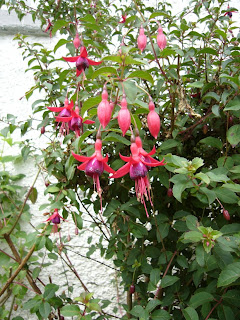 I really like this plant; its flowers always remind me of ballerinas.
Peace!
However, a recent study (Hejda & Pyšek, 2006) concludes that in some circumstances, such efforts may cause more harm than good. Destroying riparian stands of Himalayan Balsam can open up the habitat for more aggressive invasive plants such as Japanese knotweed [Reynoutria japonica] and aid in seed dispersal (by dropped seeds sticking to shoes). Riparian habitat is suboptimal for I. glandulifera, and spring or autumn flooding destroys seeds and plants. The research suggests that the optimal way to control the spread of riparian Himalayan Balsam is to decrease eutrophication, thereby permitting the better-adapted local vegetation that gets outgrown by the balsam on watercourses with high nutrient load to rebound naturally. Regarding stands of the plant at forest edges and meadow habitats, they caution that these conclusions do probably not hold true; in such localities, manual destruction is apparently still the best way to stem or slow the expansion of Himalayan Balsam.
****
So much for weeds and medicinal plants. As I've mentioned, at the bottom of my garden also grow two spectacular decorative plants, i.e. a honeysuckle that's fast becoming almost a weed, …
 … and an Indian Hawthorn, Raphiolepis Indica, which is really a joy to look at. Apparently, I should leave it to produce fruit, which can be used to make jam:
 Any input, by the way, on how best to care for these plants is most welcome -- I'm rather a novice at all this shrub and plant tending... :)
Along the south-facing wall of the house in which I live grow some lovely shrubs and herbs, some of which I have mentioned in these posts before:
There's a magnificent clump of what I like to think of as Scottish thistle …
 … standing next to …
 … a clump of white lavender, next to …
 … a deep purple lavender -- the intensity of their perfume is intoxicating! The two stand next to the one panicle (I hope this is the right word) of the Phygelius aequalis that is flowering just now (there's a whole shrub waiting to elbow back into the space I rather hacked out) …
 … and, finally, right next to the Phygelius, an in-your-face beautifully brilliant red fuchsia:
  I really like this plant; its flowers always remind me of ballerinas.
Peace!